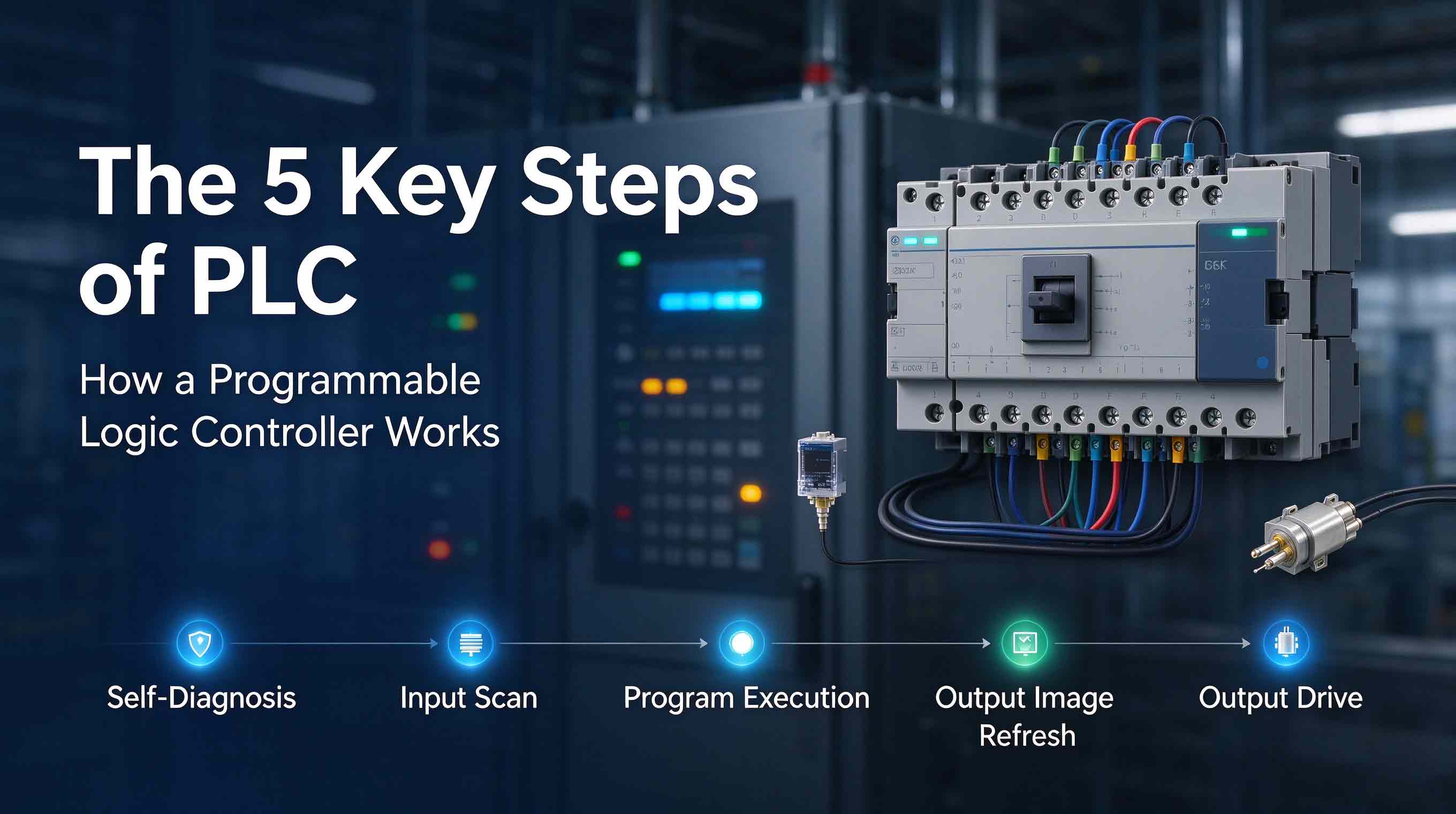
PLC (Programmable Logic Controller) is widely adopted in industrial automation for factory control, machinery operation and production line management. Many engineers and buyers know PLC can automate equipment, yet few fully understand its repeating working cycle. A PLC runs programs cyclically, and each scan cycle mainly consists of 5 core steps.
Step 1: Internal Self‑Diagnosis
At the start of every scan cycle, the PLC performs self‑diagnosis. It checks CPU status, memory integrity, power supply condition and hardware faults. If any critical error is detected, the PLC will stop executing user programs and trigger alarm signals to protect the whole system. This step guarantees stable operation before running control logic.
Step 2: Input Scan / Input Image Refresh
The PLC reads all signals from field input terminals (sensors, switches, buttons). It copies these ON/OFF status into the input image register inside memory. During this single scan cycle, input data will not be updated again even if physical input signals change. This avoids unstable signal interference while running the program.
Step 3: User Program Execution
The CPU executes your written ladder logic or structured program line by line in sequence. It reads data from input image registers and internal memory, then calculates logic results. Output status will be temporarily stored in output image registers, instead of directly driving physical output terminals at this stage.
Step 4: Output Image Refresh
After finishing the whole user program, the PLC updates the output image table. The calculated logic results are transferred to output image memory. All output status values are ready for the final output drive step.
Step 5: Output Drive
The PLC sends data from output image registers to physical output modules. It turns relays or transistors ON/OFF to control actuators such as motors, valves and indicators. Field equipment reacts accordingly to complete the control task.
Once these 5 steps are completed, the PLC immediately loops back to the self‑diagnosis step and starts a new scan cycle. The whole cycle repeats continuously during operation.
Final Takeaway
The cyclic scan mechanism is the core principle of PLC. Knowing these 5 steps helps you troubleshoot signal delay, logic error and hardware abnormal issues faster. Whether you are maintaining automation equipment or selecting PLC modules, understanding the PLC working cycle is essential for your daily work.
If you need PLC spare parts or technical consultation, feel free to contact our team.
Lunes 21/11 - Miércoles 23/11: 9:00 - 20:00 Jueves 24/11: cerrado - ¡Feliz Día de Acción de Gracias! Viernes 25/11: 8:00 - 22:00 Sábado 26/11 - Domingo 27/11: 10:00 - 21:00 (Todas las horas corresponden a la hora del este)